
SEO · 4 min read
One language gets little search traffic. Where should you check first?
Use a live four-language article to check response codes, self-canonicals, reciprocal hreflang and relevant queries.
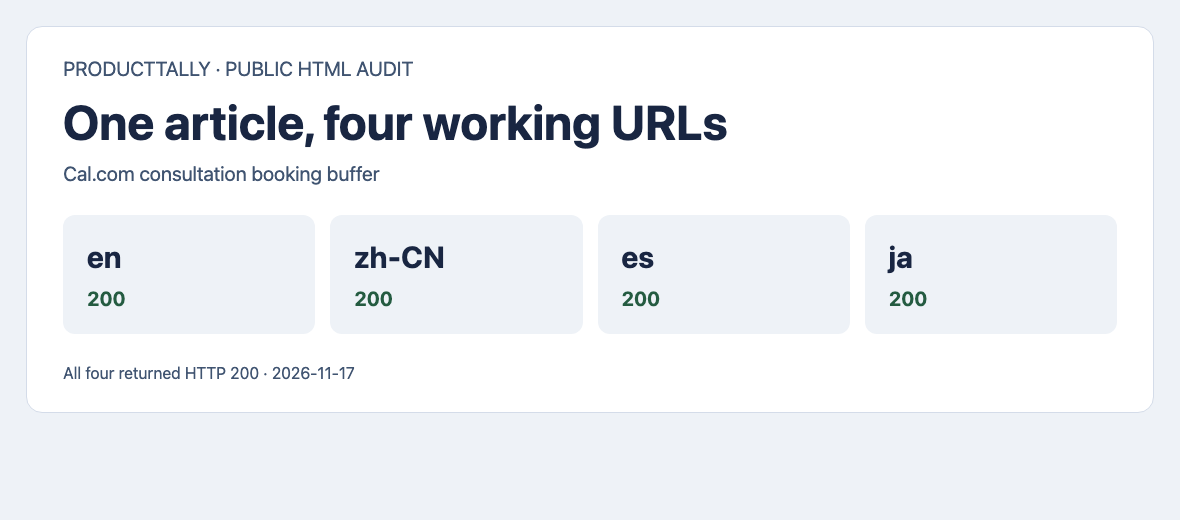
Start with the four URLs for one article. Verify that each loads, declares the intended canonical and lists the other language editions. Then inspect impressions for the individual landing page. Google explains that localized annotations help Search identify the relevant edition.
Check the URLs and the published HTML
On November 17, 2026, I fetched ProductTally's Cal.com booking-buffer guide in English, Chinese, Japanese and Spanish. All four URLs loaded and each canonical pointed to itself. Each page declared en, zh-CN, ja, es and x-default, which resolved to four distinct pages.
| Language tag | HTTP status | Canonical destination | Reciprocal alternates |
|---|---|---|---|
| en | 200 | Own URL | Four editions plus x-default |
| zh-CN | 200 | Own URL | Four editions plus x-default |
| es | 200 | Own URL | Four editions plus x-default |
| ja | 200 | Own URL | Four editions plus x-default |
Write down the requested and final URL, canonical and alternate links. Follow each alternate and verify that it links back and includes itself. Use complete URLs. If a locale redirects to English, returns 404 or unexpectedly declares the English canonical, investigate that before interpreting demand.
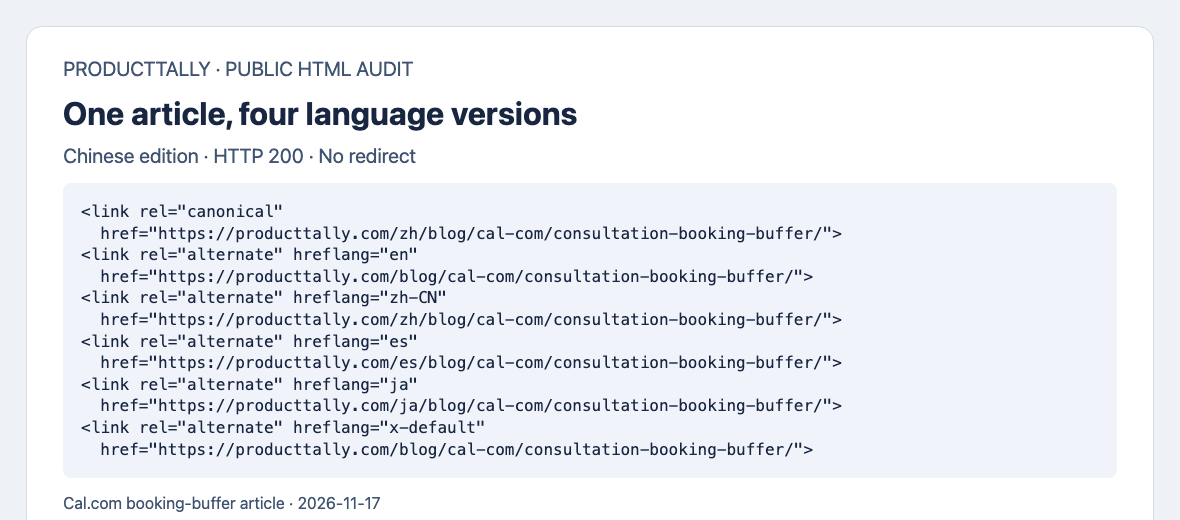
Review queries for the affected landing page
In Search Console, filter by the localized URL and use the same reporting period. Compare visible queries and their tasks with the localized title and introduction. A literal translation may miss the wording readers use in the market. When data is sparse, extend the observation window.
A successful HTML audit verifies the configurations you checked; indexing and real search exposure require their own evidence.